
Last updated on March 6th, 2026 at 07:32 am
Cryptocurrency has always been a disruptor, a challenge to traditional financial systems and a promise of greater financial inclusion. While many view crypto as a result of tech innovation, some of its major growth drivers often come from places few expect: geopolitical conflicts, sanctions, and trade wars. These events don’t just shake up global markets; they also push individuals and nations to look for new, borderless ways to move and store value.
What’s fascinating is that crypto adoption in these contexts isn’t just about speculation or escaping economic control. It’s about resilience. It’s about communities and even countries finding new ways to stay connected to the global economy when traditional systems shut them out. This article analyzes how sanctions and trade wars are not just disrupting finance but actively fueling the rise of cryptocurrency in ways that reveal its true utility and potential.
Sanctions and the Rise of “Neutral” Financial Rails
When governments impose geopolitical sanctions, the goal is usually clear: to apply economic pressure by cutting off access to global financial systems. But in recent years, these sanctions have had a surprising side effect: they’ve accelerated crypto adoption.
Here’s why: when banks close their doors and traditional payment networks become inaccessible, people start searching for alternatives. And digital assets often provide exactly that.
Chainalysis reports that in 2024, sanctioned regions received about $15.8 billion in cryptocurrency, making up around 39% of all illicit crypto transactions worldwide. This number is not only about illegal use; it shows a bigger change. When regular financial channels are blocked, DeFi and digital assets take their place.
These emerging “neutral” financial rails are powerful precisely because they’re borderless and permissionless. They don’t depend on any single nation’s banking system. Instead, they operate on a global, decentralized infrastructure that allows individuals, businesses, and even governments to transact freely without needing traditional intermediaries.
This phenomenon raises a key question for policymakers: if sanctions no longer fully isolate economies, what does that mean for financial control? On one hand, these “neutral rails” empower citizens and small businesses trapped in struggling economies. On the other hand, they challenge the effectiveness of global sanctions as a political and economic tool.
In effect, crypto is becoming the financial equivalent of the internet, an open network that routes around obstacles. As crypto adoption grows under pressure, it highlights both the resilience of decentralized technology and the growing need for smarter, more adaptable regulatory frameworks.
Geopolitical Events, Trade Restrictions, and Crypto Adoption
So, do geopolitical events affect cryptocurrency? Absolutely, and often in profound ways.
Every time a country faces sanctions, trade embargoes, or war, people look for alternatives to keep their economies moving. Crypto adoption tends to rise most where trust in traditional systems is weakest or where access to global markets is restricted.
Take the conflict involving Russia, for example. Despite facing some of the toughest sanctions in modern history, crypto activity did not fall; it increased. The Chainalysis 2024 Global Crypto Adoption Index ranked Ukraine and Russia 6th and 7th globally.

In Eastern Europe alone, Russia led with $182.44 billion in crypto inflows, while Ukraine followed with $106.1 billion, according to Chainalysis 2024 Eastern Europe Crypto Adoption.
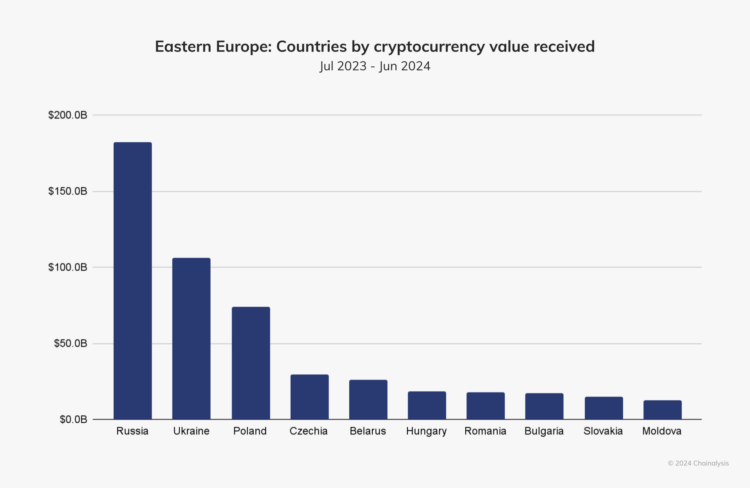
This tells a powerful story: when the traditional financial world closes its doors, crypto becomes the back door that keeps trade and liquidity alive. Businesses used it to move funds, freelancers used it to receive payments, and individuals used it to protect their savings from inflation or currency devaluation.
How does the trade war affect crypto? Trade restrictions amplify these adoption trends. When major economies impose export controls, restrict currency flows, or engage in trade wars, actors seek ways to bypass such frictions. In this context, stablecoins and cryptocurrency rails emerge as practical workarounds. For example, despite sustained sanctions, domestic economic pressures, and growing isolation from global financial networks, Iran’s cryptocurrency ecosystem has shown persistent growth and adaptation. As of mid-2025, Iranian crypto services recorded 11.8% higher volume than the same period in 2024, with reports indicating significant crypto outflows and usage in restricted jurisdictions.
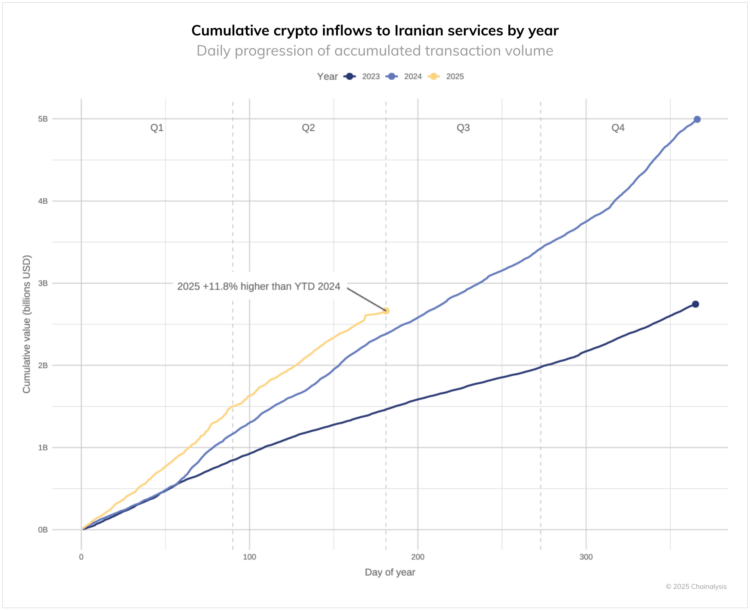
In reality, when trade restrictions get stricter, those left out of global systems can use crypto networks and stablecoins to keep trading, pay for imports and exports, or move money. This increases crypto adoption, not just for speculation, but for practical needs like hedging, sending money home, and keeping businesses running.
Also Read: Are Stablecoins The Hidden Force Behind Crypto’s Mass Adoption?
In summary, geopolitical events and trade restrictions do more than constrain traditional finance; they actively reshape it. Where conventional systems fail or are blocked, cryptocurrency offers a flexible, borderless alternative. Conflicts and trade wars can accelerate adoption in unexpected regions, yet they also introduce complex regulatory and systemic challenges that policymakers, entrepreneurs, and global financial institutions must carefully navigate.
Risks of Weaponizing Decentralised Finance
Of course, this fast adoption also has a downside. The same tools that empower financial freedom can also be used to undermine global stability. This is the risk of weaponizing decentralized finance (DeFi).
When states or non-state actors use crypto to bypass sanctions or fund illicit activity, it puts the entire ecosystem under scrutiny. We’ve already seen this play out: the U.S. government targeted Russian fintech and crypto firms accused of helping to evade sanctions related to the war in Ukraine.
Remember that 39% of illicit crypto activity in sanctioned regions? That’s not a small number; it represents a serious reputational and regulatory risk. If crypto becomes viewed primarily as a tool for bad actors, regulators will respond aggressively, and legitimate innovation will suffer.
The risks multiply fast. Exchanges, wallets, and stablecoins can all become entangled in legal battles or global crackdowns. Users in innocent regions can lose access overnight due to overreaching compliance rules. Worse, public perception can shift: if the average person starts associating crypto with conflict and crime, trust erodes, slowing down mainstream adoption.
There’s also a systemic risk. If governments start viewing crypto through a national security lens, they may treat it as a threat rather than an innovation. That could mean stricter surveillance, tighter capital controls, and fewer opportunities for open innovation.
This creates a paradox. The same conditions that fuel crypto adoption, conflict, sanctions, and trade barriers, also invite the kind of regulatory backlash that could stifle its growth. Innovation under pressure can be powerful, but if not balanced with responsibility and oversight, it can turn the industry’s biggest strength into its greatest vulnerability.
Navigating the Crypto Crossroads: Lessons for Innovation, Regulation, and Adoption
The intersection of geopolitical tension and crypto adoption offers valuable lessons for policymakers, innovators, and investors alike.
In regions where sanctions or trade frictions exist, traditional financial systems tend to fail first. That failure creates an opportunity, a gap that crypto fills. Entrepreneurs operating in these markets often build faster, leaner, and more resilient financial solutions. They create payment rails, remittance systems, and DeFi tools that serve people who would otherwise be excluded.
For regulators, this should be a signal, not a surprise. The crypto industry doesn’t just emerge where it’s allowed; it thrives where it’s needed most. But for this growth to be sustainable, regulatory frameworks must evolve beyond reactionary measures. Instead of broad bans, governments should focus on differentiating between innovation and illicit activity. That approach builds trust and keeps legitimate users engaged.
The reputation factor also can’t be ignored. Crypto’s long-term success depends on people seeing it as a tool for empowerment, not for avoiding rules. When people associate it with financial inclusion, transparency, and innovation, adoption grows naturally. But if headlines keep connecting it to sanctions and conflict, progress could slow down.
Another critical lesson is the need for global coordination. Since crypto flows are borderless, disruptions in one part of the world can ripple across the entire ecosystem. Harmonized standards, transparent compliance tools, and cross-border regulatory cooperation are essential to ensure stability without crushing innovation.
Ultimately, crypto adoption in crisis-hit regions underscores its core promise: freedom, access, and resilience. But it also highlights the need for balance. Policymakers must protect financial integrity without suffocating progress. Innovators must build responsibly, with transparency and security at the forefront.
From Sanctions to Adoption: The New Crypto Frontier
Geopolitical conflicts, whether in the form of sanctions, trade wars, or capital controls, have a paradoxical effect: they often accelerate crypto adoption instead of suppressing it. The rise of neutral financial rails, the creative use of stablecoins, emerging crypto hubs, and even weaponized DeFi illustrate a financial ecosystem that adapts and evolves under pressure. For regulators and industry players, the challenge is no longer simply how to oversee cryptocurrency in stable conditions, but how to channel the innovation sparked by conflict into secure, inclusive, and sustainable financial systems. If approached thoughtfully, this surge in crypto adoption offers more than speculative markets; it presents a blueprint for alternative financial infrastructure, one that can empower users in restricted or crisis-hit economies while fostering responsible innovation globally.
Disclaimer: This article is intended solely for informational purposes and should not be considered trading or investment advice. Nothing herein should be construed as financial, legal, or tax advice. Trading or investing in cryptocurrencies carries a considerable risk of financial loss. Always conduct due diligence.
If you want to read more market analyses like this one, visit DeFi Planet and follow us on Twitter, LinkedIn, Facebook, Instagram, and CoinMarketCap Community.