
Gensyn (AI), a decentralized AI infrastructure network with its native token AI, is drawing attention after Binance listed the token under the ticker AIGENSYN on May 14, 2026. The project targets AI developers, researchers, and node operators, aiming to create an open network for machine learning computation instead of relying entirely on centralized cloud clusters. Interest in Gensyn has risen amid the crypto market’s close monitoring of AI infrastructure, decentralized compute, and autonomous agents.
Gensyn Explained
Gensyn is a protocol for machine learning computation. According to Gensyn Docs, the network provides a standardized way to execute machine learning tasks across a wide variety of devices, ranging from personal GPUs to large-scale compute infrastructure.
The project aims to pool distributed compute supply into an open network where those who need to run AI workloads can connect with those who have computational resources. Instead of relying entirely on a few large cloud providers, Gensyn aims to build a permissionless infrastructure layer for AI training, inference, and other machine learning tasks.
Gensyn’s coordination layer is built as an Ethereum rollup. This approach helps the project target use cases such as AI model training, inference, distributed compute, evaluation markets, and applications that need to verify that a machine learning task has been performed correctly.
How Gensyn Works
Gensyn operates through four main layers:
Execution layer: runs ML tasks consistently across multiple device types.Verification system: checks whether the work has been performed correctly.Peer-to-peer communication: shares workloads among nodes in the network.Decentralized coordination layer: manages identity, incentives, payments, and settlement on-chain.
In this network, submitters submit workloads, such as training jobs, inference requests, or benchmarks, to be run. Solvers provide compute to perform the work, typically using GPUs or hardware suitable for AI workloads.
After a solver completes a task, the results are not accepted based on trust alone. Gensyn uses a verification layer to check whether the work has been performed correctly. Instead of requiring every node to rerun the entire training job, the system can use probabilistic checks and execution proofs to evaluate the results at a lower cost.
Verifiers are the group that checks the work of solvers. If the results are verified, the solver can receive payment or rewards. If there is dishonest behavior, staking and slashing mechanisms can create economic risks for the wrongdoer. This is how Gensyn handles a core problem of decentralized AI compute: verifying ML work without needing a central party to guarantee it.
AI Token Utility And Tokenomics
AI is the native token of the Gensyn Network. On Binance, this token is listed under the ticker AIGENSYN to avoid confusion with other assets using the AI ticker. According to Gensyn Network Docs, the AI token is used to coordinate economic activity within the network, including compute payments, staking and verification, evaluation markets, and governance.
Specifically, AI is used to pay fees for verified training or inference work, staked to participate in the verification process, and to be used in governance for decisions such as protocol upgrades, ecosystem programs, and treasury deployments. The token also has a role in evaluation markets, where participants can stake on specific models or outcomes.
The total supply of AI is 10 billion tokens. According to the official tokenomics, the initial allocation includes:
Community Treasury: 40.4%Investors: 29.6%Team: 25%Community Sale: 3%Testnet Rewards: 2%
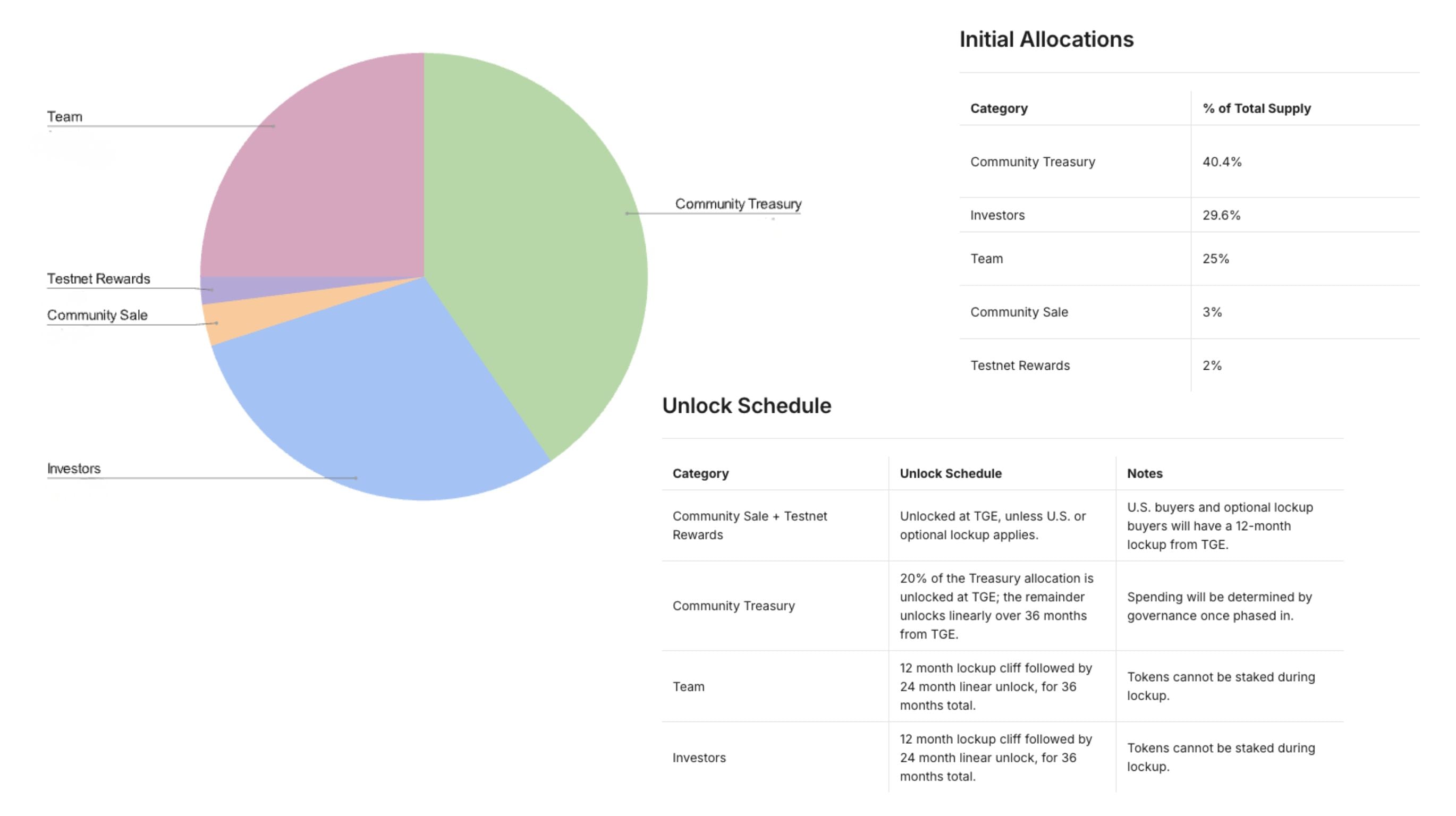
AI token allocation. Source: Gensyn Network.
Regarding the unlock schedule, the Public Sale is unlocked at TGE, except for certain lockup cases applicable to US buyers or those who chose to lock up. The Community Treasury unlocks 20% at TGE, with the remainder unlocking linearly over 36 months. The team and investors have a 12-month cliff, followed by linear unlocking over 24 months.
According to CoinMarketCap data, Gensyn is trading around $0.0286, with a market capitalization of approximately $37.4 million, a 24-hour trading volume of about $11.8 million, and a circulating supply of around 1.304 billion AI, equivalent to about 13% of the maximum total supply.
Delphi And The Buyback-Burn Mechanism
A notable feature of Gensyn is Delphi, the first practical application introduced by the project for machine intelligence markets. According to Gensyn, Delphi is a prediction market for machine intelligence, where users can stake on AI models they believe will perform better in specific benchmarks or tasks.
Instead of just viewing static model leaderboards, Delphi creates a market where the price of each model can change based on the expectations of participants. As models are evaluated, market results reflect which model performs better in each task. Revenue from evaluation markets can be used to buy back and burn AI tokens.
Why Gensyn Is Drawing Attention
Gensyn drew broader attention after Binance listed AIGENSYN on May 14, 2026, with AIGENSYN/USDT, AIGENSYN/USDC, and AIGENSYN/TRY trading pairs, while applying the Seed Tag. The Binance listing helps the token access greater liquidity but also places Gensyn in a category of new assets with higher risk and volatility.
This interest comes as AI infrastructure and decentralized compute remain sectors closely monitored by the crypto market. Gensyn targets the compute demand for AI workloads in a context where GPUs and model processing infrastructure remain crucial parts of the AI wave. Therefore, the extent to which Gensyn attracts developers, researchers, and compute providers will be a key factor in assessing the actual utility of the AI token.
Key Risks For AI
AI or AIGENSYN is still a new token and has been assigned the Seed Tag by Binance, a label designated for assets with higher risk compared to many long-listed tokens. For a token that has just hit a major exchange, new capital inflows can be accompanied by unpredictable price movements.
Gensyn still needs to prove real-world demand from developers, researchers, and node operators. If activity on the network is not large enough, the utility of the AI token may be limited.
In addition, only about 13% of the maximum total supply is circulating at the time of recording. A low circulating supply can make the token more sensitive to short-term capital flows, while future unlocks remain a factor to monitor.
The Bottom Line
Gensyn is a decentralized AI infrastructure network focused on connecting machine learning compute demand with distributed hardware supply. The AI token is used within the ecosystem for activities such as compute payments, staking, verification, evaluation markets, and governance.
The attention surrounding Gensyn stems from its Binance listing, the AI infrastructure narrative, and the buyback-burn mechanism linked to Delphi. However, the project’s long-term prospects still depend on the actual utilization rate of the network, its ability to attract compute providers, and pressure from the uncirculated token supply.