I was rewatching The Martian the other night, watching the main character desperately try to survive on a barren planet by farming potatoes in the most ridiculous, hostile conditions imaginable. For years, I always filed that concept away in my brain under “pure Hollywood magic.” But while going through the latest research papers this morning, I realized something wild: that sci-fi survival tactic is rapidly becoming our actual scientific reality.
If humanity is going to establish a permanent base on the Moon—which is the entire goal of the upcoming Artemis missions—we have a massive logistical nightmare to solve. We can’t just order a pizza delivery from Earth. The shipping costs for a single pound of food to the Moon are astronomical. We have to learn how to farm in space.
And thanks to a fascinating new study from Oregon State University (OSU), it looks like the humble potato might be our ticket to off-world survival. Let me break down how space biologists are turning dead lunar dust into agricultural gold, and why this matters for the future of human exploration.
The Problem: Moon “Dirt” is Dead

Before we talk about the breakthrough, we need to understand the enemy. The surface of the Moon isn’t covered in soil; it’s covered in regolith.
If you’ve ever struggled to keep a simple balcony tomato plant alive (and trust me, I have), imagine trying to grow food in regolith. It is essentially a layer of crushed, jagged rocks, minerals, and glass shards created by billions of years of meteorite impacts.
It is completely sterile. There are no microbes, no fungi, and absolutely zero organic matter.It is physically harsh. The particles are sharp and static-charged, making it terrible for delicate plant roots.
To test if anything could survive in this nightmare material, OSU space biologist David Handy and his team didn’t have access to pounds of actual moon dirt—it’s incredibly rare and heavily guarded by NASA. Instead, they had to engineer a highly accurate laboratory simulation using crushed minerals and volcanic ash.
But when they tried to plant crops in this raw simulated regolith, nothing happened. The environment was simply too harsh and devoid of nutrients. They needed a catalyst.
The Secret Ingredient: 5% Worm Manure

This is where the science gets incredibly practical, and maybe a little bit gross. The researchers realized they needed to introduce a highly efficient, compact source of organic matter to kickstart the regolith. They chose vermicompost—essentially, worm manure.
The results were genuinely shocking. By adding just a 5% ratio of worm manure to the simulated lunar dirt, the team was able to successfully grow potato plants.
Here is what the two-month experiment looked like behind the scenes:
The potatoes were planted in the 5% amended regolith and monitored constantly in a controlled lab environment.Despite the harsh physical nature of the simulated dirt, the plants took root and grew.After the growth cycle, the team didn’t just look at them; they harvested, freeze-dried, and ground the potatoes down to a powder for intense genetic and chemical analysis.
The Good, The Bad, and The Toxic
When I read the lab results of these “moon potatoes,” I was fascinated by how plants react to extreme stress. The DNA analysis showed that the plants had heavily activated their stress-related genes. They knew they were in a hostile environment, and they fought hard to survive.
According to Handy, the plants had to expend a massive amount of extra energy just to cope with the terrible soil conditions. But here is the amazing part: despite the struggle, the baseline nutritional value of these potatoes remained remarkably similar to the ones you buy at your local grocery store. However, there is a catch that we need to talk about:
Heavy Metal Absorption: The analysis revealed that these lab-grown potatoes contained significantly higher levels of copper and zinc compared to Earth-grown potatoes.The Health Risk: While we need small amounts of these minerals to survive, high concentrations can become toxic for human consumption.
This means that while we can grow the food, we still need to figure out how to filter or manage the heavy metals present in the lunar crust before astronauts can safely eat a plate of moon fries every day.
NASA’s Reality Check: The Lab vs. The Vacuum
As much as I want to celebrate this as a total victory, I always like to look at the broader context. Jared Long-Fox, a lunar scientist from NASA’s Jet Propulsion Laboratory (JPL), provided a much-needed reality check on this study.
He praised the OSU team’s work as a massive step forward, but he pointed out the elephant in the room: a greenhouse on Earth is not the Moon. The OSU experiment simulated the dirt, but it couldn’t simulate the other lethal factors of the lunar surface:
Zero Atmosphere: The Moon is a vacuum.Extreme Radiation: Without an atmosphere or magnetic field, the surface is bombarded by solar radiation that shreds DNA.Wild Temperature Swings: Going from boiling hot in the sun to freezing cold in the shadows.
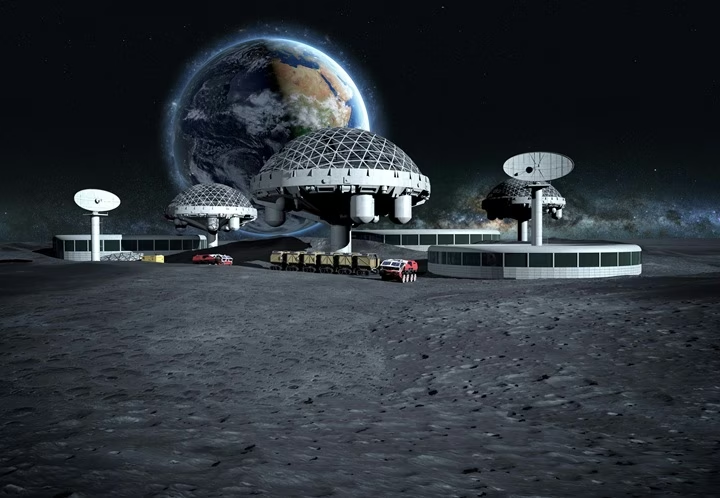
Long-Fox noted that the true test will only happen when the Artemis program brings back larger, diverse samples of actual lunar soil, allowing us to test these crops against the real deal, perhaps even on the upcoming Lunar Gateway space station.
Building the Off-World Future
So, what is the next step? We aren’t just going to pack standard Idaho potatoes onto a rocket.
Aymeric Goyer, a plant biochemist at OSU, stated that the team’s next goal is aggressive genetic selection. They plan to test dozens of different potato varieties to see which ones naturally handle the stress of the regolith best. Eventually, they want to genetically engineer a specific “Lunar Potato” that is perfectly adapted to survive off-world.
When I look at studies like this, I don’t just see agricultural science. I see the foundational code being written for humanity’s expansion into the stars. We are learning how to hack biology to survive in environments that actively want to kill us. It’s challenging, it’s dangerous, but it is undeniably exciting.
I’m really curious about your limits when it comes to space exploration. If you were stationed on a newly built lunar base, would you be brave enough to eat a potato grown in radioactive moon dust and worm compost, or would you stick to the freeze-dried Earth rations? Let me know your thoughts in the comments below!