Analyst Weekly, March 30, 2026
Last week’s losses signal an increasingly fragile market backdrop as macro pressures begin to build. While investors have focused on inflation from higher energy prices, the bigger risk is the impact on global growth if prices stay high. There are already early signs that higher energy costs are beginning to weigh on demand in parts of the global economy, reinforcing this concern.
Markets typically react to this shift through sentiment first. Investors become more cautious and less willing to pay high prices for stocks, meaning markets can fall even before company earnings are meaningfully affected. This helps explain why the near-term risk to equities is less about a sharp drop in earnings, and more about a reset in valuations.
Positioning already reflects this caution.
There has been a lack of aggressive call buying, indicating that investors are not yet confident enough to chase upside. At the same time, demand for puts (protection) remains relatively firm. In simple terms, investors are preparing for risks rather than positioning for a strong rally.
This is also visible in volatility. Day-to-day market moves remain relatively contained, but options markets continue to price in higher risk. This gap suggests that while markets are not breaking, they are becoming more sensitive to negative surprises, particularly if higher energy prices begin to weigh more meaningfully on demand.
Investment Takeaways for Retail Investors
1. Stay invested, but take a more balanced approach
Markets are under pressure, still they are not breaking. This supports staying invested, but avoiding aggressive risk-taking. Focus on maintaining a balanced allocation rather than increasing exposure at this stage.
2. Don’t chase protection, build resilience instead
Protection is already expensive in the options market. Rather than reacting:
Stay invested in companies with stable earnings
Reduce exposure to more speculative, high-valuation names
Focus on diversification and gradual positioning
Avoid emotional decisions driven by headlines
3. Add defensive elements to your portfolio
Investment Takeaway: Markets are not in a state of panic, still, they are becoming more fragile. Investors are already positioning more defensively, and risks are shifting from inflation alone to broader concerns around growth and sentiment.
For retail investors, this is not a time for bold bets. It is a time for discipline, selectivity, and balanced portfolio construction.
Gold Stumbles, but the Long-Term Case Holds
Gold’s recent volatility doesn’t mean its role as a safe-haven status is broken, but it does challenge how investors think about it. In our opinion, the latest selloff reflects an unwind of crowded positioning rather than a shift in fundamentals. After a strong rally, gold had become heavily owned by investors via ETFs, leveraged trades and options, leaving it vulnerable to a sharp reversal when the dollar strengthened and rate expectations shifted.
That said, gold is not a linear hedge. In periods of market stress, it can initially fall as investors raise cash and reduce risk, particularly when positioning is extended. This can create the impression that it is “failing” as a haven, when in reality it is behaving like a liquid asset in a stressed system.
The underlying drivers remain intact. Central bank buying, ongoing diversification away from fiat currencies, and geopolitical uncertainty continue to support demand. If anything, the recent move highlights that gold is a long-term hedge, not a short-term shock absorber.
For investors, the takeaway is that gold still plays a role in portfolios, but expectations around its behavior need to be more realistic.
S&P 500 Approaches Correction Territory
The S&P 500 fell another 2.5% last week, marking its fifth consecutive week of losses. The index is now more than 9% below its record high. A decline of 10% is officially considered a correction. Such pullbacks typically occur once a year, while larger drops of 20% or more tend to happen only every few years (see chart). The triggers may differ, but currently the conflict in the Middle East is driving a clear risk-off sentiment. Looking at history, markets have repeatedly recovered and gone on to reach new highs. For now, the S&P 500 has only approached correction territory.
In such weak phases, so-called fair value gaps are often tested, which can act as potential support zones. The next one lies between 6,187 and 6,201 points, followed by another between 6,050 and 6,173 points. This does not mean these levels must be reached, but the probability has increased in recent weeks. A short-term trend reversal typically begins with a move above a recent high. This would require a sustained breakout above last week’s high at 6,694 points, along with a move back above the 20-week moving average, which sits slightly above that level. Until then, the risk of another lower low remains elevated.
S&P 500, weekly chart. Source: eToro
Nike Under Pressure
Nike shares have already declined by around 19% this year. Last week, the stock closed another 1.9% lower at $51.37, marking its lowest level since 2017. This puts the company on track for a fifth consecutive year of losses. Overall, the stock is down more than 70% from its record high. At the moment, the main focus is on preventing a further selloff. Buyers are pushing against a long-term downtrend.
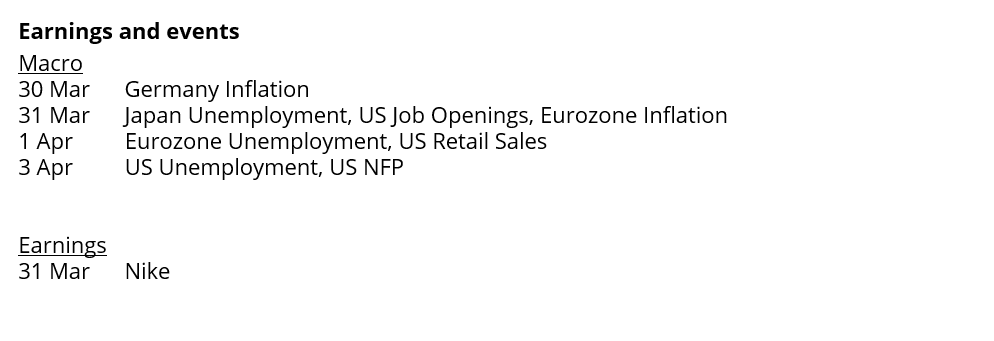
To break the structure of lower highs and lower lows (see chart), the stock would first need to reclaim the double top formed in February around $68. Without this breakout, there is no new upward trend. A period of stabilization followed by a recovery could at least improve the short-term outlook. Any signs of de-escalation in the Middle East could also quickly lift overall market sentiment. Investors are looking to Tuesday evening’s earnings release for more concrete signals on the company’s outlook.
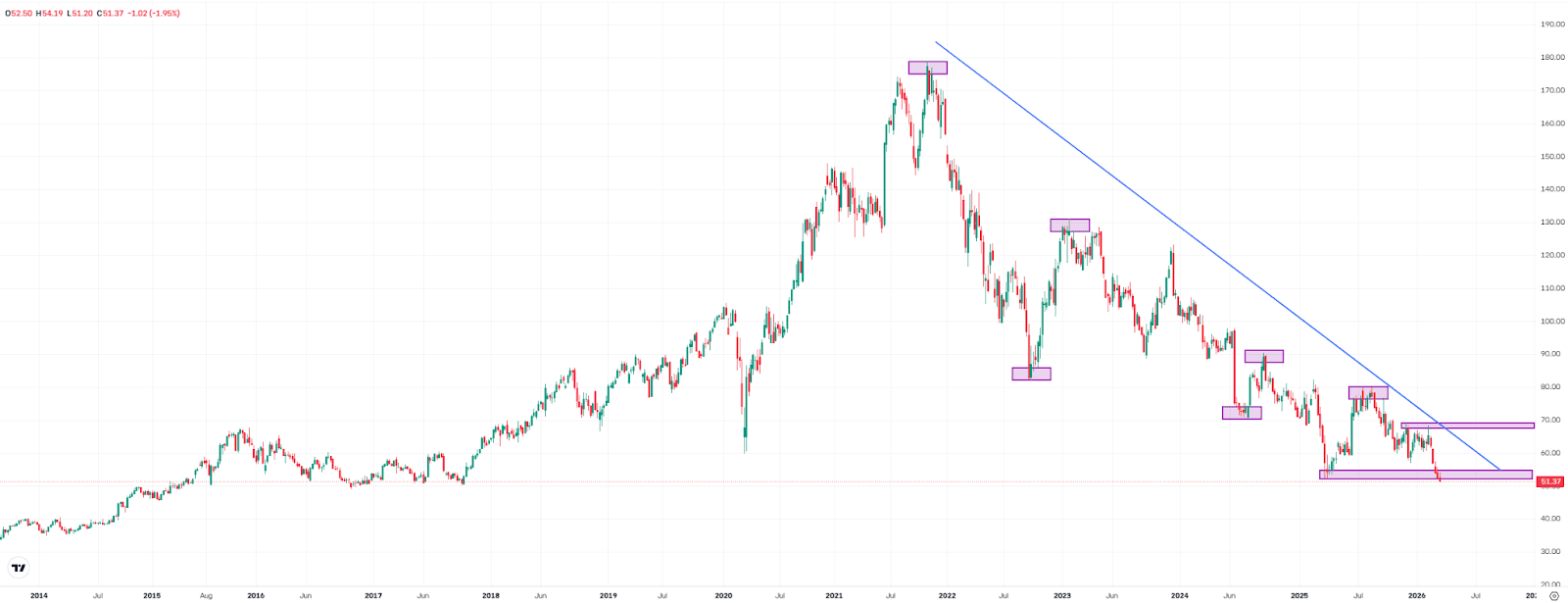
Nike, weekly chart. Source: eToro
Bitcoin Holds Support as Markets Turn Defensive
Bitcoin holds above the $65K key support after the weekly correction. Dominance above 55% confirms a defensive environment where capital shelters in BTC rather than rotating to altcoins. Volumes contract while “Fear & Greed index” drops below 15 again.
On-chain data remains mixed. Retail investors (<10 BTC) accumulate on weekly balances. Whales (>1000 BTC) sell into rebounds. ETFs record negative weekly flows breaking the prior monthly trend.
Macro pressures non-yielding BTC with elevated real yields, strong dollar and geopolitical carry trades. Extreme pessimism opens room for tactical bounces. Market doesn’t resolve this tensión, it prices it into 65-75K USD laterals.
Structural integration is no longer optional, it is underway. Nasdaq and New York Stock Exchange are embedding crypto into core market infrastructure, from clearing to derivatives, while Fannie Mae is testing bitcoin as mortgage collateral.
As traditional finance absorbs crypto into its rails, the direction of price may remain uncertain, but the trajectory of the system is not. The next phase of the market will be built within this convergence.
This communication is for information and education purposes only and should not be taken as investment advice, a personal recommendation, or an offer of, or solicitation to buy or sell, any financial instruments. This material has been prepared without taking into account any particular recipient’s investment objectives or financial situation and has not been prepared in accordance with the legal and regulatory requirements to promote independent research. Any references to past or future performance of a financial instrument, index or a packaged investment product are not, and should not be taken as, a reliable indicator of future results. eToro makes no representation and assumes no liability as to the accuracy or completeness of the content of this publication.