I was recently lying by the pool on vacation when my bank started another “scheduled” system maintenance. The app went down, cards were declined. What saved me was a backup card from a reliable payment crypto provider. A few clicks and the money was available.
Standing in line for coffee, a thought struck me: why, in 2026, do even large companies still make payments and daily operations so unnecessarily complicated for everyone involved?
Even Big Businesses Struggle with Over-Complexity
Most large companies face the same trap: they try to build everything in-house. They think that if they have their own payment infrastructure, their own key management, their own security layers, their own integrations, they will be in full control. But more often than not, it causes more problems, not less.
Companies like Uber, Ryanair, or major retailers don’t avoid modern payment technologies because they don’t want the revenue.
They are simply afraid of the complexity.
They believe that they need to put together teams of architects, backend developers, DevOps engineers and cybersecurity specialists, operate their own servers, and constantly update the system to meet new regulatory and market requirements.
This is a myth.
What is a Wallet-As-A-Service and Why Does It Save Businesses?
Imagine you want to open a coffee shop. You don’t buy coffee plantations in Colombia and build a roasting factory from scratch. You just buy roasted beans and rent an espresso machine.
When you travel, you rent a flat on Airbnb or call an Uber, utilizing shared infrastructure to save millions of dollars.
WaaS is the sharing economy for cryptography. Instead of building their own custody “hotel” from scratch, businesses rent a secure cloud-based wallet via an API.
Of course, there are various providers on the market, and I often sit down with my clients to discuss which solution fits best. When looking specifically at infrastructure provided by major cryptocurrency exchanges (who, if not exchanges, know how to scale wallet operations best?), here is my personal Top 5 exchange-based WaaS solutions to consider:
⬛ Coinbase Onchain Wallet an industry giant backed by Coinbase’s brand trust, utilizing MPC-based key management, publicly-verifiable backups, and native fiat on-/off-ramps.
⬛ WhiteBIT WaaS enables businesses to easily accept crypto payments through a simple API integration that provides ready-made wallets with automatic AML compliance, secure key storage, and zero hidden fees without needing node deployment.
⬛ Ceffu. Binance’s institutional custody partner, offering off-exchange settlements, zero-trust architecture, and instant access to the world’s deepest liquidity pools.
⬛OKX Web3 Wallet — a highly interoperable solution supporting 140+ blockchain networks, advanced smart accounts, and proactive threat detection.
⬛ Bitget Wallet WaaS — high-performance Web3 wallet infrastructure with native support for 100+ mainnets, backed by a massive user protection fund and flexible DeFi integration options.
The Real Cost of Building In-House
Let’s look at the real numbers and map out the trade-offs. Building an in-house wallet in Europe (e.g., Germany) requires hiring a team of ~30 people and developing the product for at least 6 months.
Average monthly salaries for senior tech specialists in Germany as of 2026 (sourced from verified German market databases CareerCheck and WeAreDevelopers)
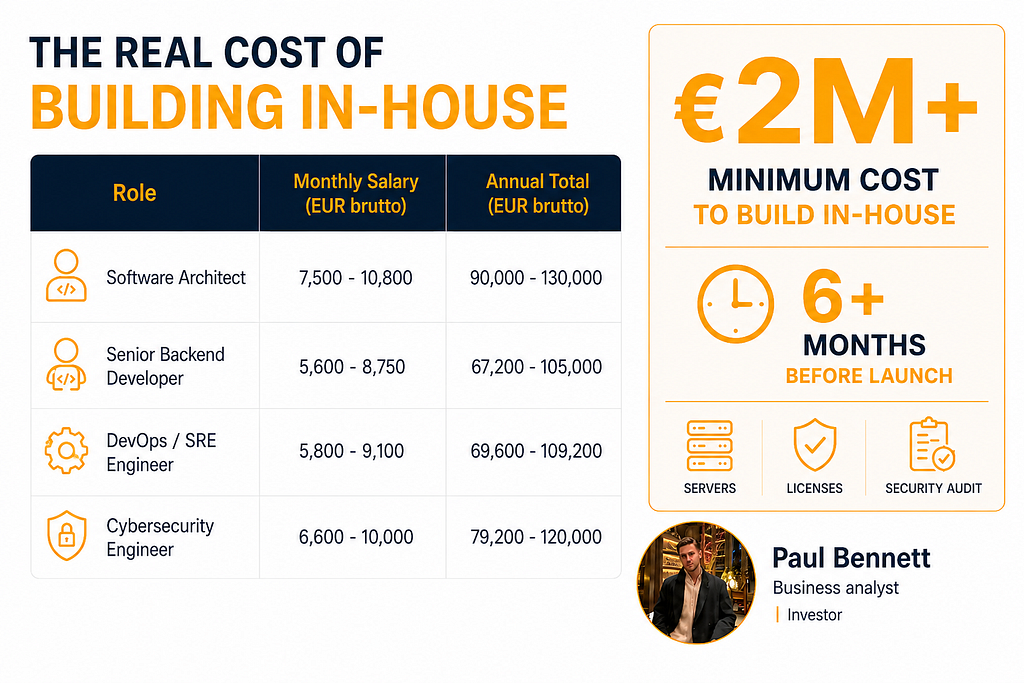
By comparison, while final costs and timelines will always depend on your specific project scope and technical requirements, market statistics from leading WaaS providers show a highly cost-efficient trend.
Integrating a cloud solution typically ranges from $100,000 to $400,000, and the platform can go live in just a few weeks. As statistics show, opting for WaaS can save up to 70% of the budget compared to custom in-house builds and drastically shortens time-to-market with a compliant, battle-tested system.
Why In-House Often Becomes Problematic
The problem goes beyond money and time. When a company builds everything itself, it also takes on permanent maintenance, regulatory updates, incident handling, and compatibility issues. Most businesses don’t want to become IT companies. They want to sell tickets, coffee, or travel experiences.
On top of that, overly complex infrastructure makes partnerships much harder. Lengthy KYB processes, demands for massive documentation from day one, and slow manual checks cause potential partners to drop off before they even test the product.
A Simple Conclusion
I completely understand why some CEOs and companies are cautious. From conversations with clients, I see how difficult it has become to close deals — and this isn’t only about big B2B projects. The growing complexity affects businesses of all sizes. That’s exactly why we need to make things simpler for everyone.
Let infrastructure providers do what they do best — build and maintain reliable infrastructure. And let businesses do what they do best — scale operations and generate revenue.
The sharing economy already transformed travel, accommodation, and transportation. It’s time it finally transforms business infrastructure too.
Disclaimer: This is not financial or investment advice. Do your own research before making any decisions. Use at your own risk.
€2,000,000 vs. €100,000: Why Renting Infrastructure Beats Building It Yourself was originally published in The Capital on Medium, where people are continuing the conversation by highlighting and responding to this story.