
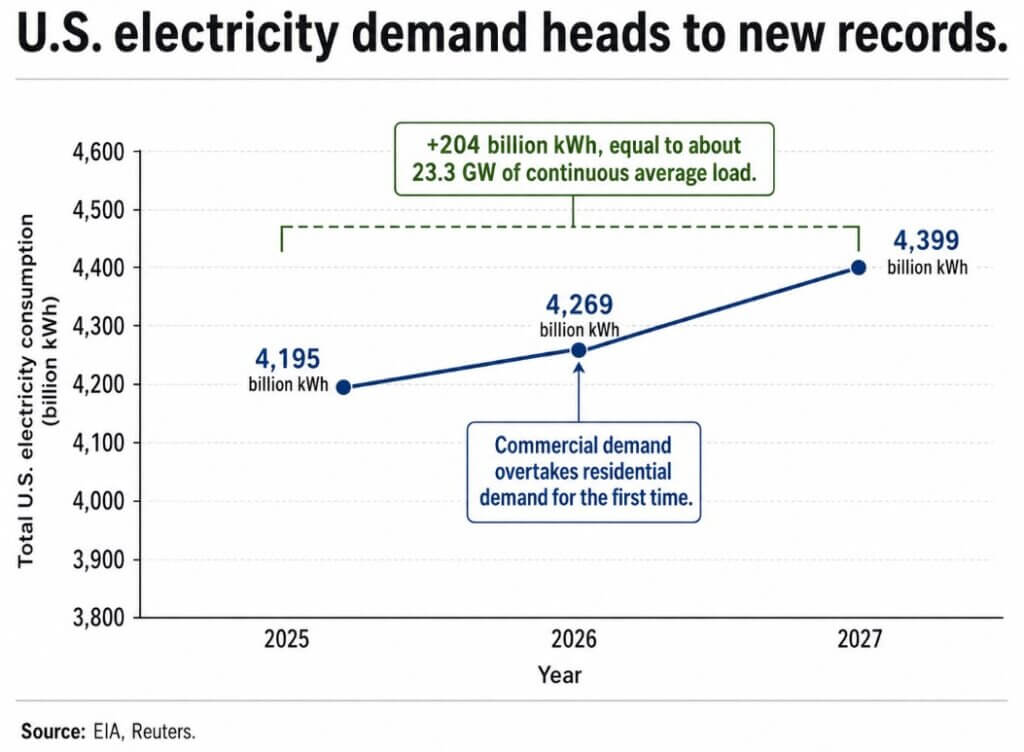
Bitcoin miners are facing a real-world test of their ability to improve the electricity grid. The US Energy Information Administration projects electricity consumption will climb from 4,195 billion kilowatt-hours in 2025 to 4,269 billion in 2026 and 4,399 billion in 2027.
The agency ties the increase to AI data centers, cryptocurrency operations, and broader electrification, and both years would set records for the country. The two-year climb adds 204 billion kilowatt-hours to the grid, equal to about 23.3 gigawatts of continuous average load.
The number arrives alongside a first for the sector: commercial electricity use overtakes residential demand in 2026, at 1,550 billion kilowatt-hours against 1,508 billion for households, a gap of 42 billion kilowatt-hours.
Miners have spent years competing against each other for cheap power contracts, and the 2026 data puts them in the same category as AI data centers, manufacturers, and electrified households, all drawing from the same grid sized for a slower pace of demand.
Proving a different kind of load
The Electric Reliability Council of Texas defines a large flexible load as any facility with an expected peak demand of 75 megawatts or more, and identifies large-scale computing facilities, including data centers and cryptocurrency mining operations, as a leading source of demand growth in the state.
ERCOT has built voluntary curtailment agreements with large-load facilities, primarily crypto miners, along with some data centers and industrial factories, that reduce demand when system demand climbs or generator availability drops.
The EIA has said that flexibility can ease the strain on the grid from demand growth, and curtailment depends on whether the compensation is worth it to the customer.
A 2026 working paper on Texas mining load found that Bitcoin mining demand responds to wholesale power prices and to the incentives tied to coincident-peak transmission charges, a response that weakens as the hash price climbs.
Miners curtail most reliably when mining revenue per unit of hashpower is lower, a pattern that can weaken when Bitcoin’s hashprice rises, even if the grid is under stress.
Load typeGrid behaviorWhat grid operators care aboutRisk for minersAI data centersHigh-uptime, firm electricity demandReliability, interconnection capacity, backup power, load growthAI may win priority because it is framed as strategic infrastructure.Bitcoin minersPotentially interruptible and price-sensitiveVerified curtailment, demand response, voltage ride-through, predictable behaviorFlexibility weakens when hashprice rises or incentives are too low.ManufacturersLess flexible, politically protected loadCost stability, jobs, regional competitivenessManufacturers may blame large new loads for higher capacity charges.HouseholdsPeak-sensitive residential demandAffordability, reliability, heat-wave protectionRatepayer backlash can turn miners into an easy political target.Renewables-linked loadsCan absorb surplus generation if designed wellAbility to shift demand toward oversupply hoursMiners must prove they reduce curtailment instead of adding scarcity pressure.
Where the test is running
PJM Interconnection, which covers 13 states, gave the grid a preview of what scarcity pricing looks like this summer.
The EIA’s July 2026 outlook forecasts wholesale power to average about $45 per megawatt-hour this summer, a figure that hides what a single heat wave can do to that average.
Wholesale power prices in Virginia jumped from about $40 per megawatt-hour to over $600 during that heat wave, with PJM demand approaching a record near 160 gigawatts and a forecast peak of 166.3 gigawatts.
PJM later said emergency conservation measures and demand-response programs held the system below that new record. The gap between a $45 average and a $600 spike is the gap that flexible load is supposed to close.
Data-center-driven capacity charges across PJM’s 13-state region have climbed by over 1,000%, and one Ohio manufacturer cited a monthly capacity charge that rose from $1,600 to $12,000.
Any large commercial load, including mining, now risks becoming the target when ratepayers and manufacturers look for a reason for that bill.
ERCOT has identified four groups of large loads, including data centers and crypto mining facilities, with more than 5,000 megawatts at risk of disconnecting during certain grid faults.
The operator has logged at least 26 data center or crypto-mining disconnection events since 2023, making ride-through performance a live reliability issue for miners seeking grid access.
What flexible megawatts could be worth to Bitcoin miners
In the bear case, miners fall short of the ride-through performance or the measurable curtailment record that grid operators want to see by 2027.
Interconnection reviews get harder, power contracts get pricier, and pure mining sites lose valuation ground relative to operators who can point to AI or high-performance computing leases.
In the bull case, miners turn curtailment into a documented, dispatchable service. The EIA’s July 2026 outlook puts renewables at 27% of 2027 generation, with wind and solar at 21% and hydropower at 6%, while coal accounts for 15% of the total generation mix.
That combination raises the value of a load that can absorb a renewable surplus in one hour and disappears during the next hour’s scarcity price.
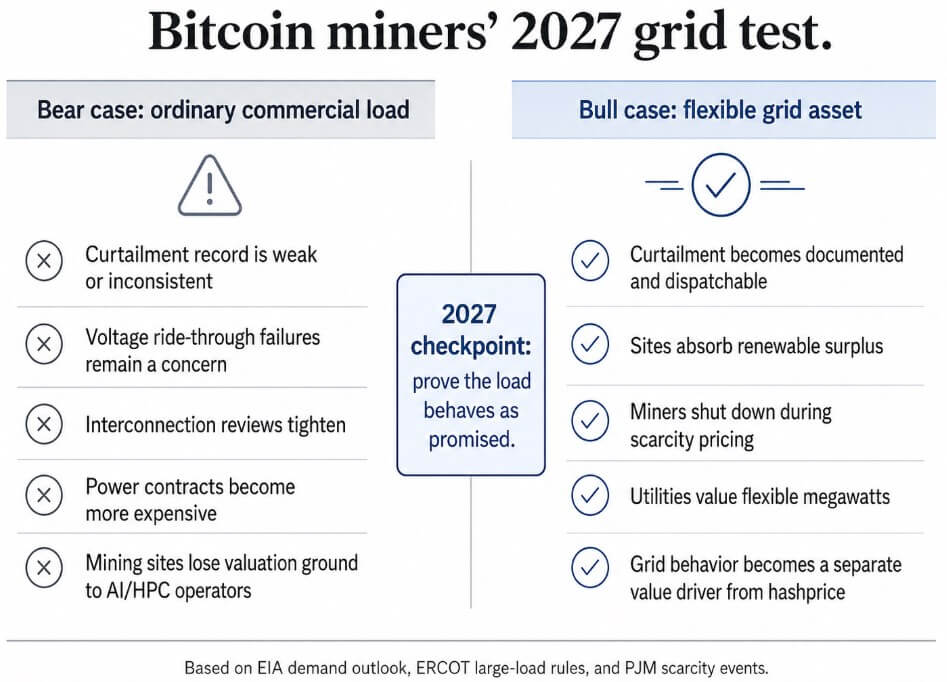
Flexible megawatts earn a premium tied to grid behavior in that case, a separate value driver from hashprice, most visibly in ERCOT-style markets built to reward it.
A single gigawatt of continuous load draws about 8.76 billion kilowatt-hours per year, or 6.57 billion at 75% utilization and 4.38 billion at 50% utilization.
Hashrate Index estimated that the US held 37.5% of global Bitcoin hashrate in January 2026, while the EIA’s 2025-2027 demand increase across the full US power market amounts to more than 20 gigawatts of continuous load.
The 2027 mark in the EIA’s forecast serves as a data checkpoint: the point at which the country’s grid operators will have collected enough data to know which large loads behave as their operators promise.
Documented curtailment, survival through a voltage event, and a demonstrated appetite for renewable surplus would let a mining site hold flexible megawatts that utilities are willing to protect through the next scarcity event.