James Dicke II, the chairman and chief executive of Crown Equipment Corportation, one of the world’s largest forklift truck manufacturers, is a long-time admirer of James Turrell, the renowned Light and Space artist. He has followed Turrell’s epic, ongoing Roden Crater project in northern Arizona and visited his famous light installations around the globe when he and his wife travelled overseas. “They’re amazing experiences,” Dicke II says, “and it’s been fascinating to watch how, over the years, they’ve become more sophisticated.”
Finally, Dicke II decided he wanted a Turrell closer to home and company headquarters. In 2023, the executive began discussions with the artist about creating a new Skyspace installation for his community in New Bremen, Ohio, a town of around 3,000 people in a rural area. The project, which consists of an enclosed chamber with a retractable roof, is scheduled to open in 2027. At the end of this year, Dicke II will open the city’s new Modern Aboriginal Art Museum. “It would be wonderful if New Bremen, Ohio became the Marfa of the Midwest,” he says. “We aspire to have enough here that’s interesting, that it’s worth the trip.”
New Bremen is located in western Ohio, about an hour north of Dayton and even closer to the Indiana border. It sits on the edge of the Miami Valley, at a watershed between the Great Lakes and the Ohio River. “It is very flat here,” Dicke II says. “You might be forgiven for thinking that the landscape looks a little bit like Kansas.” Though the executive’s projects will serve as major cultural anchors, he highlights an existing local attraction: New Bremen is already home to the Bicycle Museum of America.
An aerial view of a portion of the Kuenning-Dicke Natural Area in New Bremen, Ohio, the future home of a James Turrell Skyspace installation Photo courtesy of the New Bremen Foundation
A Turrell-approved engineering team will install the Skyspace in New Bremen’s Kuenning-Dicke Natural Area, a former family farm that features 77 protected outdoor acres along with 2.5 miles of trails. The Skyspace will connect to this network of paths, making it a “destination within a destination”, according to Dicke II. He adds that it will be open to the public, which appealed to the artist.
Turrell was also excited “that the natural area is far enough from town that there won’t be a lot of light pollution”, says James Dicke III, the president at Crown Equipment. This will enhance evening viewings, when visitors will likely able to see the stars.
Thanks to new technology, the Skyspace roof will also be able to roll back, allowing viewers to see what Dicke II calls its “light magic” when it’s snowing, raining or otherwise subject to inclement weather.
This latest installation contributes to Turrell’s ongoing series of over 50 years. He created his first Skyspace for the home of Count Giuseppe Panza di Biumo in Varese, Italy in 1974, cutting into the ceiling to create an overhead aperture through which to see the sky (the piece is on long-term loan from the Guggenheim). To enhance the experience, he filled the interior room with both natural and neon light. In the intervening years, Turrell has replicated and refined his process as he’s created around 100 Skyspaces from Tokamachi, Japan to Bogotá and Beverly Hills.
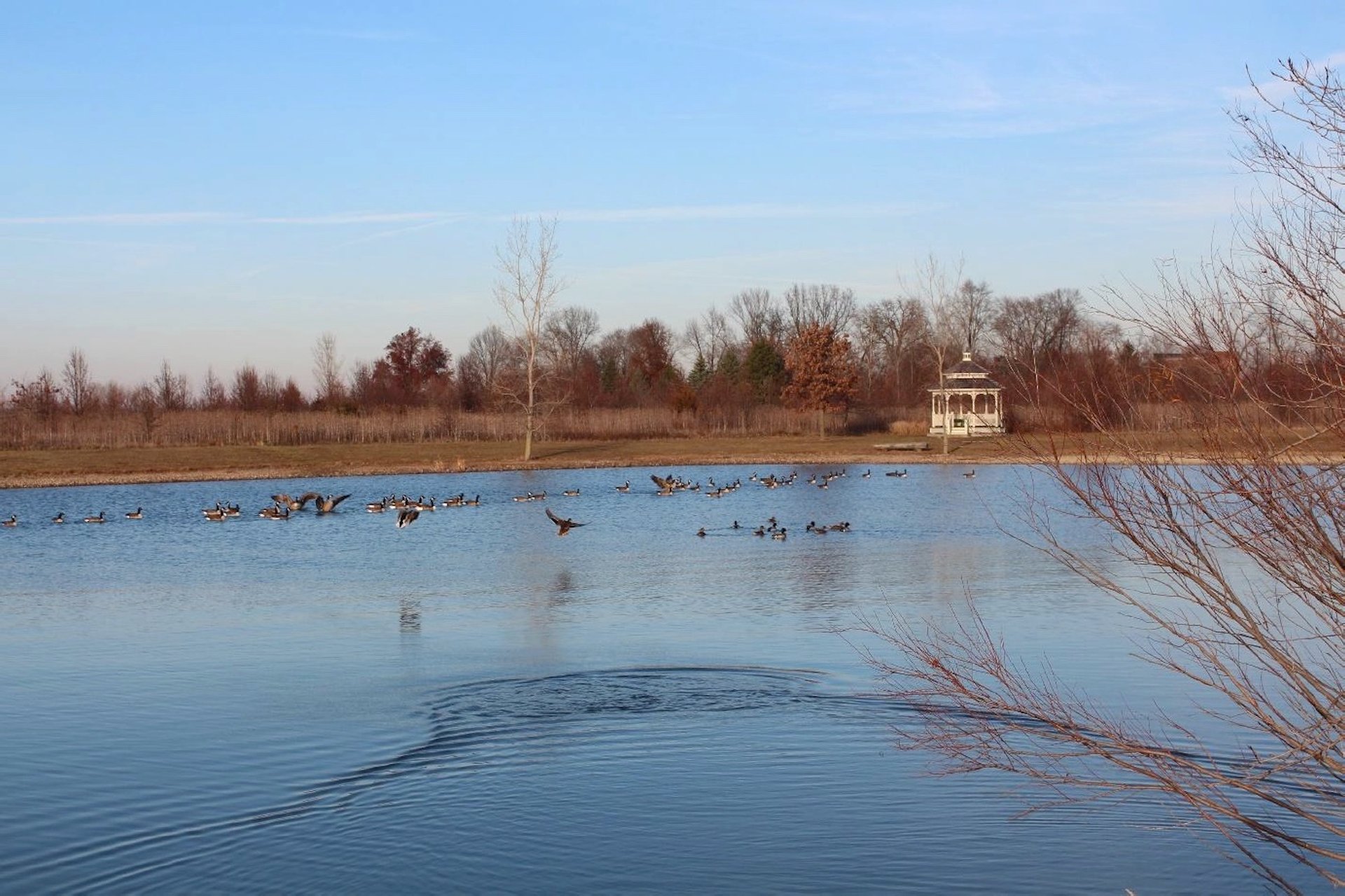
A gazebo is located along the walking path near a pond in the Kuenning-Dicke Natural Area in New Bremen, Ohio Photo courtesy of the New Bremen Foundation
If New Bremen’s Skyspace connects visitors more deeply to the elements just above the city, the Modern Aboriginal Art Museum will allow them to engage with cultures halfway across the world. Crown has had roots in Australia for over 60 years, and Dicke II’s related travel introduced him to the continent’s Indigenous art practices.
Though Dicke II began collecting Aboriginal art in 2016 because of his business’s commitment to Australia, he has become enchanted with the storytelling elements in the work. “Aboriginal culture doesn’t have a written language, so they communicate their traditions, stories and heritage from generation to generation,” Dicke II says. He is equally interested in the scope of the work’s materials, including sand, coloured clay and eventually canvas and paint. One piece in his collection even features an oil pan from a rusted Ford truck that was abandoned in the outback.
Dicke II has focused on contemporary art in his collecting, which he says stands a better chance of conservation over time. He and his team will install more than 100 paintings and sculptures from his collection in the single-storey, 23,700-sq.-ft museum, which opens later this year. Artists featured will include Malaluba Gumana, Angelina Pwerle (Ngale), Rammey Ramsey and Doreen Reid Nakamarra. The museum will feature one of the largest collections of its kind in North America.
“It will be a wonderful opportunity for someone to dig in as much as they like,” Dicke II says. “You can enjoy how fabulous the paintings are. You can also dig a little deeper and know what they’re all about.”