
With at least nine senior Ethereum Foundation (EF) members having left in 2026 and years of community frustration over EF-linked ETH sales, Vitalik Buterin posted his perspective on the Foundation’s direction.
For Buterin, the EF should become smaller, more opinionated, and less central to Ethereum’s future.
He said this reflects his view alone and that the board is expanding while his own power within the organization continues to decrease, which he described as what he wants.
The dispute now centers on Ethereum Foundation ETH sales, treasury discipline, and whether outside groups can take over the growth functions holders want EF to own.
That framing puts Buterin directly at odds with a vocal segment of ETH holders who want the Foundation to behave more like a growth-oriented institution, competing harder against Solana, building the ETH-as-asset narrative, coordinating business development, and stepping up execution.
QuestionETH-holder demandVitalik’s answerWhat should EF be?Growth-oriented institutionOne node among manyWhat should EF optimize for?ETH value, adoption, executionCROPS: censorship resistance, open source, privacy, securityWhat should EF do with ETH?Stop or reduce sellingSell less by becoming narrowerWho handles BD and asset narrative?EF should coordinate itOutside organizations should step inWhat is the risk?Ethereum under-competesEthereum becomes too centralized if EF does too much
He describes EF as “one node, with a defined purpose, alongside other nodes,” and says it should prioritize longevity over breadth, a choice he explicitly ties to selling less ETH.
Aya Miyaguchi is executing much of the transition, with Buterin’s own input concentrated on technical matters.
The Ethereum Foundation holds approximately 0.16% of all ETH, well below the 10% to 50% foundation allocations Buterin says are common at other blockchain projects. In April, the Ethereum Foundation staking move reached roughly 69,500 ETH, nearly completing a 70,000 ETH target and shifting part of its treasury toward yield generation.
The estimated annual staking income of $3.9 million to $5.4 million is well below historical EF operating costs of nearly $100 million per year, and staking leaves the need for ETH sales intact.
The Ethereum Foundation treasury therefore remains dependent on either lower spending, continued ETH sales, outside funding, or some combination of all three.
Selling less ETH, under these conditions, means a smaller, narrower EF by fiscal necessity as much as by philosophical design.
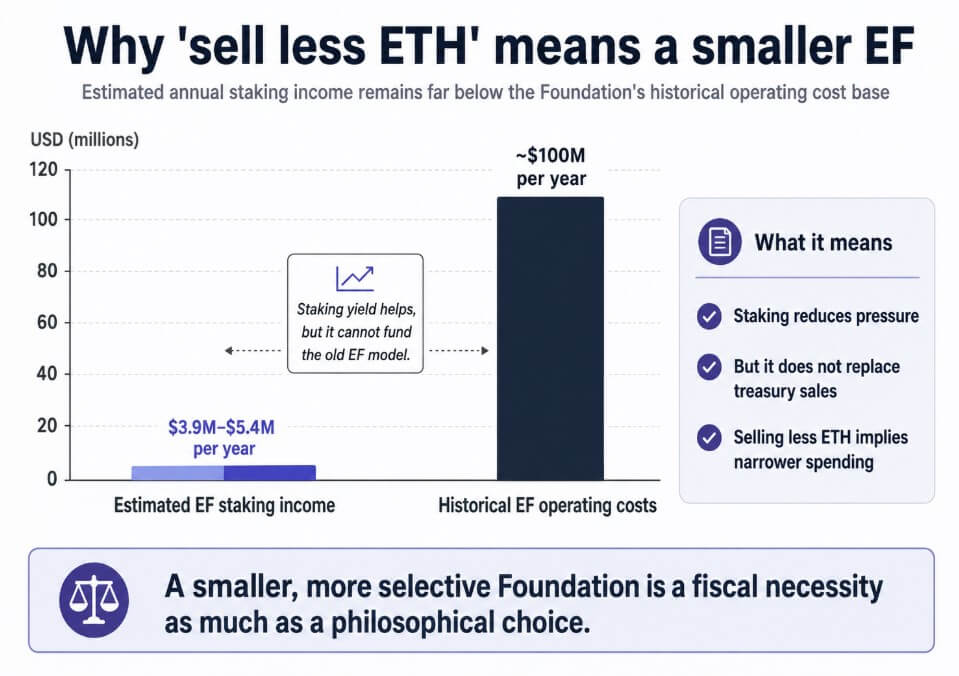
Ethereum Foundation smaller by design
The deeper argument in Buterin’s post runs through the Mar. 13 Ethereum Foundation Mandate, which formalized censorship resistance, open source, privacy, and security as Ethereum’s core institutional identity.
The Mandate described EF as one of many stewards, with EF success measured by reducing EF dependence over time.
Buterin’s post noted that EF will focus specifically on activities that only EF can credibly deliver, some of which Buterin describes as newly achievable through AI-assisted proof systems, while treating ETH asset promotion, coordination, and business development as work for outside organizations to absorb.
Buterin made a Google analogy to illustrate that a single institution holding a more idealistic position produces more durable value for the broader field than all institutions bending to prevailing pressures.
In a technology landscape drifting toward financial capture and surveillance, the Ethereum co-founder said that EF positioning itself as something resistant to those pressures creates more value for Ethereum than EF competing as another growth-oriented institution.
Community voices argued that Ethereum needs an organization focused on ETH the asset winning, executing hard, and getting loud in institutional markets. Buterin acknowledges that supporting ETH the asset requires work EF assigns to outside organizations.
Buterin frames the recent Ethereum Foundation brain drain as decentralization in practice, necessary to attract outside capital to important tasks, and leaves unanswered whether outside capital and institutions materialize quickly enough to absorb that work.
The subtraction test for the Ethereum
A smaller, more ideological EF reduces ETH treasury selling, holds the technical roadmap through CROPS-focused work, and gives Ethereum’s base layer a credibility that growth-oriented foundations trade away.
External organizations, funded by private capital and ETH-aligned institutions, absorb the asset narrative, business development, and coordination functions the EF vacates.
Ethereum decentralizes in practice and in protocol, and ETH benefits from a cleaner institutional structure, with treasury selling pressure dropping at the base layer while a competitive field of external groups drives adoption independently.
Buterin’s formal verification ambitions, intermediary-minimization work, and lean-consensus research produce the kind of technical depth that institutional allocators and developers price into long-term positions.
If the EF loses institutional knowledge faster than external groups absorb it, Buterin’s decentralization thesis becomes brain drain dressed up as philosophy.
Upgrade timelines slip alongside departures, and the organizations Buterin counts on to fill the growth gap form slowly or arrive with insufficient capital and coordination to replace what the EF built across a decade.
With staking generating $3.9 million to $5.4 million per year against historical operating costs near $100 million, “sell less ETH” translates into spending cuts that accelerate departures before outside institutions can credibly step in.
ScenarioWhat happensWhat ETH holders seeSignal to watchBull caseExternal groups absorb BD, asset narrative, adoption and coordinationLess EF selling, more decentralized executionNew ETH-aligned institutions gain funding and credibilityBase caseEF shrinks, but outside groups fill gaps unevenlyLower treasury pressure, slower coordinationSome functions move outside EF, but execution remains fragmentedBear caseEF loses institutional knowledge faster than replacements formSmaller EF looks like weaker executionMore departures, roadmap delays, weak outside fundingBlack-swan caseMajor technical or governance stress tests Ethereum without strong EF coordination“One node” thesis faces a real crisisEmergency coordination, delayed upgrades, public governance disputes
ETH holders, watching Solana attract institutional capital through centrally coordinated asset narratives, read a smaller EF as a sign of execution weakness.
Buterin ends his post by calling EF a smaller ship than in previous years, more opinionated, but longer-lasting. Meanwhile, ETH holders who have spent years asking for a bigger ship are now being told Ethereum needs a different kind of vessel entirely.
The bet Buterin’s smaller ship is making is if Ethereum can outsource growth without outsourcing urgency.