
Movement Labs raised $38 million in an April 2024 Series A led by Polychain Capital.
By July 22 this year, MVMT Labs’ bankruptcy filing showed just $100,001 to $1 million in estimated assets against $1 million to $10 million in liabilities, with 200 to 999 creditors listed.
After the company filed for Chapter 11 Subchapter V protection on July 15, creditors now face a more immediate question: which assets and claims remained with the debtor as Movement’s operating structure changed?
MVMT Labs was the company behind Movement Labs, the original developer of Movement Network. Its projects included the M1 and M2 blockchains, as well as Move Stack, an open-source framework for building networks with the Move programming language.
MVMT Labs is the only named debtor in Delaware case 26-11113-TMH. The Movement Network, Movement Network Foundation, Move Industries, Movement Limited and the MOVE token are not named debtors in the case.
Move Industries CEO Torab said on July 21 that MVMT Labs has no affiliation with Move Industries and that his company is not involved in the bankruptcy.
Torab supplied the current operator’s account. The legal boundary still depends on court records and agreements. The Foundation’s December 2025 announcement supports a change in operating roles while leaving the relevant ownership and transfer terms undisclosed.
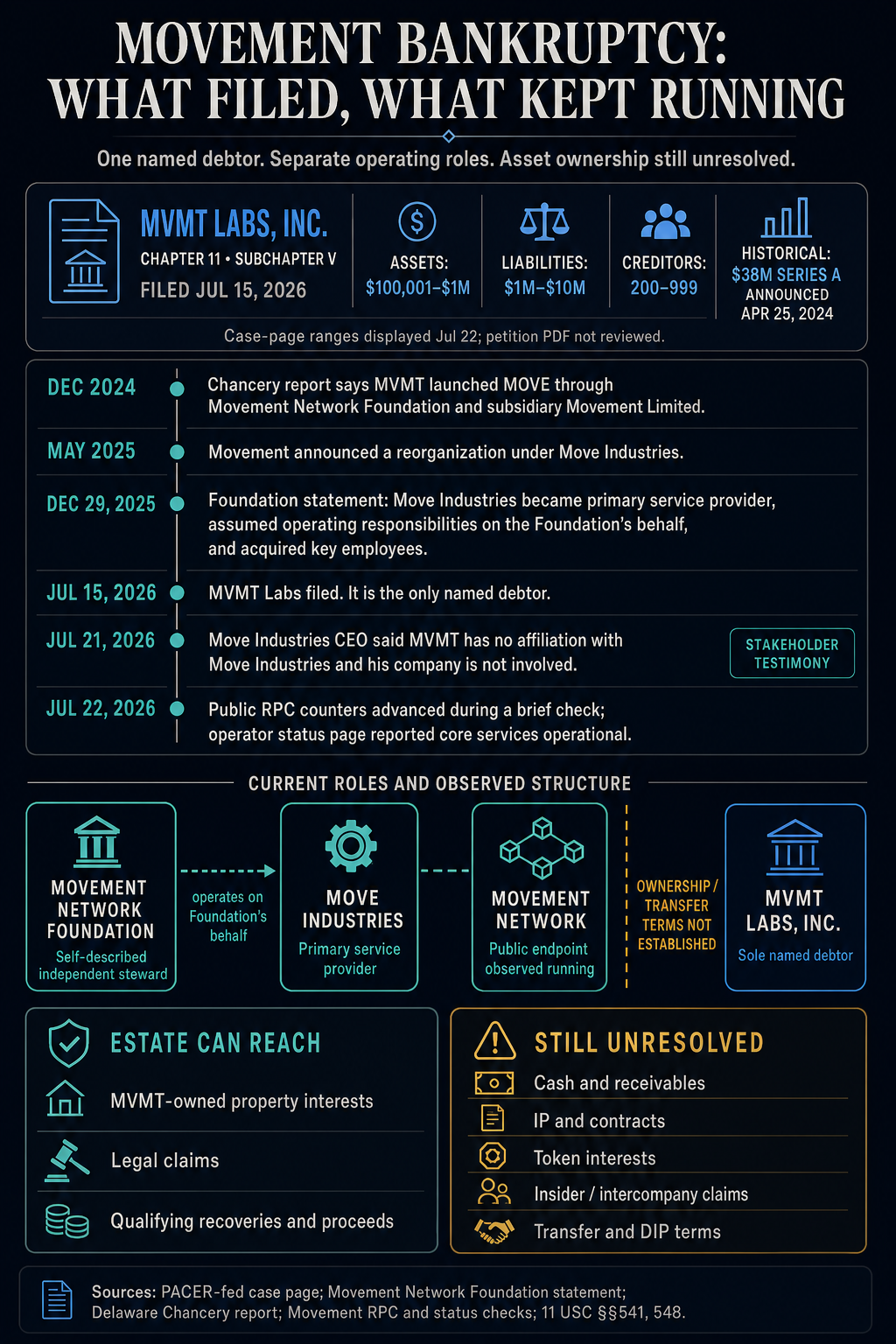
The operating split predates the bankruptcy
Movement’s present structure took shape during 2025, after a governance and market-making crisis and the departure of co-founder Rushi Manche.
Movement announced a reorganization under Move Industries in May. On Dec. 29, the Foundation said it had completed an operating change that made Move Industries its primary service provider.
According to that announcement, Move Industries assumed primary operating responsibilities for the network on the Foundation’s behalf and acquired key employees. The Foundation described itself and its board as independent stewards, while Move Industries would build, operate, and grow the ecosystem for it.
The announcement leaves the transferor, consideration, and asset list unspecified. It establishes the operating roles the Foundation described, while ownership of bankruptcy-relevant rights remains unresolved.
Entity or assetEstablished rolePosition in this caseUnresolved exposureMVMT Labs, Inc.Historical technology developer and the only named debtorIts property interests and qualifying claims or recoveries enter the estateCash, IP, contracts, token interests, legal claims, intercompany balances and obligationsMovement Network FoundationDescribed itself in December 2025 as the network’s independent stewardNot a named debtorRelevant assets, agreements, claims against MVMT and obligations to MVMTMovement LimitedFoundation subsidiary identified in the MOVE launch historyNot a named debtorCurrent role and any relevant holdings or agreementsMove IndustriesBecame the Foundation’s primary service provider under the December 2025 announcementNot a named debtor; its CEO asserts no affiliation with MVMTTerms behind the operating change and employee acquisitionMovement NetworkPublic endpoint remained responsive after the filingNo network filing is listedDependence on any rights or contracts owned by MVMTMOVEToken continued trading after the filingThe token itself is not a debtorAny MOVE interests held by MVMT and their treatment in the estate
A March 2026 Delaware Court of Chancery report described MVMT Labs as the technology-development company that created the Movement blockchain. It said MVMT launched MOVE in December 2024 through Movement Network Foundation and its subsidiary, Movement Limited.

The bankruptcy docket index identifies a debtor-in-possession financing motion at Dkt. 19, a sealed exhibit at Dkt. 20 and Michael Robinson’s first-day declaration at Dkt. 21. The captions do not reveal the financing amount or terms. They also do not explain Project Fenix, the operating-change consideration, MVMT’s exact cash, ownership of IP and contracts, token interests, or insider and intercompany balances.
What enters MVMT’s estate
Estate boundaries turn on MVMT’s property interests.
Section 541 of the Bankruptcy Code creates an estate comprising the debtor’s legal and equitable interests in property when the case begins, together with specified recoveries and proceeds. In MVMT’s case, that could include cash, receivables, contractual rights, intellectual property, token holdings and legal claims, but only to the extent MVMT owns them.
Property owned outright by a separate non-debtor remains outside MVMT’s estate even when it supports the same ecosystem. Only an ownership interest tying value to MVMT could bring the Foundation’s property, Move Industries’ property, or MOVE holdings into the estate.
Creditors can also benefit from claims that belong to the estate. Section 548 provides a mechanism to avoid qualifying transfers of debtor property or obligations made within two years before bankruptcy when the statute’s tests are proved. The public docket index supplies no basis to classify the employee acquisition, service arrangement, Project Fenix, or another Movement-related transaction as qualifying.
The possibility still puts transaction documents at the center of the case. If MVMT transferred property before filing, creditors and the court will need to know what moved, what consideration MVMT received, and which rights it retained. Property that always belonged to another entity remains with that owner despite MVMT’s role in creating the network.
A separate Chancery proceeding identifies a potential obligation without fixing its bankruptcy treatment. The March Rule 144 report concluded that Manche was entitled to advancement from MVMT for fees connected to a federal investigation, plus fees-on-fees and prejudgment interest. The report remains subject to exceptions and implementation and fixes neither an allowed bankruptcy claim nor a claim amount.
The schedules and statement of financial affairs should begin to show MVMT’s cash, receivables, contracts, litigation claims, token holdings, insider balances and debts. Ownership and transfer disputes may continue beyond those disclosures.
Network activity leaves ownership unresolved
Movement’s official documentation identifies mainnet as chain ID 126 and lists its public RPC. During a brief endpoint check at 11:59 UTC on July 22, the ledger version advanced from 180,558,734 to 180,558,762, and block height increased from 77,828,052 to 77,828,066 over about five seconds. The operator’s status page simultaneously reported the mainnet, RPC, explorer, and indexer as operational.
At 12:21 UTC that day, CryptoSlate’s MOVE market page showed the token at $0.011, down 93% since last July, with a market capitalization of about $44.26 million and $9.38 million in 24-hour volume.

Those snapshots show the network and token were still moving. What they do not reveal is where MVMT’s property ended, and the wider Movement ecosystem began.
MOVE ownership by itself confers neither debtor nor creditor status in MVMT’s case. A holder could have separate exposure through a claim against MVMT, while the token’s market value could react to disclosures about assets, financing or litigation.
Builders and business partners will have to follow the paperwork. A responsive RPC shows that the network was available during the check. Each service, grant, license or commercial agreement still must be matched to MVMT, the Foundation, Move Industries or Movement Limited. The named counterparty may determine whether the agreement is implicated in Chapter 11 and whether another Movement entity has a claim against or obligation to MVMT.
For creditors, network activity and estate value are separate measures. Recovery depends on property MVMT owns, claims it can pursue, and any qualifying prepetition transaction it can challenge.
Four dates could clarify the boundary
The case calendar lists a Section 341 creditor meeting for Aug. 20, a second-day hearing for Aug. 27 at 11 a.m., a general claims deadline for Sept. 14, and the Subchapter V plan deadline for Oct. 13.
The Aug. 27 hearing may clarify the financing request. Schedules and other disclosures may illuminate the estate’s assets and obligations, while objections could show whether creditors, the U.S. Trustee or the Subchapter V trustee contest a prepetition transaction or the asserted separation.
For now, the filing establishes a limited but important divide: MVMT Labs is the only named debtor, and the Movement Network remained operational after the petition.
Whether MVMT owns or can recover value tied to that ecosystem will turn on the disclosures, agreements, and court disputes that have yet to surface.